
Best 4,001 to 6,000 Sq Ft Routers in 2026: 10 Picks
Looking for Wi-Fi coverage across 4,001 to 6,000 sq ft means choosing a mesh system, and the eero Pro 7 is our top pick. It combines Wi-Fi 7, a tri-band radio layout, a three-node package, and support for internet plans up to 5 Gbps, which makes it the most complete specification sheet in this class. To build this guide, 10 mesh systems from the product catalog were compared on coverage, Wi-Fi generation, band count, node count, and extra features. Prices are live on the page, and no unit here has been used by the site.
10 picks from 19 routers that match this guide with a price we can quote today, made by 29 makers. Each price below is read live and stamped with the time it was read.
The short list
Who each pick suits
- For a three-node Wi-Fi 7 setup: If you want the latest Wi-Fi generation and more hardware to spread across a large home, the eero Pro 7 is the most complete pick in this group. See pick 1
- For a two-node Wi-Fi 7 setup: If your floor plan allows two well-placed nodes, the NETGEAR Orbi 870 Series is a straightforward Wi-Fi 7 mesh with stated coverage for this range. See pick 6
- For a home with many older devices: The eero 6 mesh supports more than 75 connected devices and uses Wi-Fi 6, which is a good match for a busy household on a slower internet plan. See pick 5
The 10 picks, one by one
1 Best overall

Amazon eero Pro 7 tri-band mesh Wi-Fi 7 router
- Wi-Fi standard
- Wi-Fi 7
- Bands
- Tri-band
- Coverage
- 4,001 to 6,000 sq ft
- Pack size
- 3 pack or more
- Mesh
- Yes
- Multi-gig port
- Yes
$799.99 (as of 10/26/2026 22:46 PDT - Details)
The eero Pro 7 is the only pick in this list with Wi-Fi 7, a tri-band layout, a three-node pack, and support for internet plans up to 5 Gbps. That combination gives it the highest ceiling for a large smart home.
Pros
- Wi-Fi 7 with tri-band radios
- Three-node pack for 4,001 to 6,000 sq ft coverage
- Supports internet plans up to 5 Gbps
- Stated coverage of 4,001 to 6,000 sq ft
Cons
- Processor and memory specifications are not stated by the seller
- No stand-alone router mode detail is given in the listing
Good fit if
- Homes with multi-gig internet plans
- Users who want a tri-band Wi-Fi 7 mesh out of the box
Skip if
- You want a smaller two-node system
- Your internet plan is well below 1 Gbps
Verdict: The eero Pro 7 is the most feature-complete mesh system in this coverage class.
2 Best three-node Wi-Fi 7 mesh

NETGEAR Orbi 370 Series WiFi 7 Mesh System
- Wi-Fi standard
- Wi-Fi 7
- Bands
- Dual-band
- Coverage
- 4,001 to 6,000 sq ft
- Pack size
- 3 pack or more
- Mesh
- Yes
- Multi-gig port
- Yes
$299.99 (as of 10/26/2026 17:10 PDT - Details)
The NETGEAR Orbi 370 is a Wi-Fi 7 mesh system in a three-node package with stated coverage up to 6,000 sq ft. If you want the current Wi-Fi generation without moving to a tri-band radio layout, this is a simpler way to cover the full range in this class.
Pros
- Wi-Fi 7 support
- Three-node package covers up to 6,000 sq ft as stated by NETGEAR
- No separate satellite purchase is required for full coverage
Cons
- Band layout is not stated by the seller
- Internet plan speed and Ethernet port speed are not stated by the seller
Good fit if
- Homes that want Wi-Fi 7 in a three-node kit
- Users who do not need tri-band radios
Skip if
- You want a tri-band mesh system
- You need a stated multi-gig port speed
Verdict: The Orbi 370 is a straightforward Wi-Fi 7 mesh for the full 4,001 to 6,000 sq ft range.
3 Best compact two-node Wi-Fi 7 mesh

Tenda WiFi 7 Mesh System BE3600
- Wi-Fi standard
- Wi-Fi 7
- Bands
- Dual-band
- Speed class
- 2001 to 5000
- Coverage
- 4,001 to 6,000 sq ft
- Pack size
- 2 pack
- Mesh
- Yes
$129.99 (as of 10/26/2026 20:05 PDT - Details)
This Tenda system covers a stated 4,600 sq ft with two nodes and Wi-Fi 7. The dual-band layout and speed class in the 2,001 to 5,000 range make it a leaner option for a home that is just inside this coverage band.
Pros
- Wi-Fi 7 with dual-band radios
- Two-node pack covers up to 4,600 sq ft as stated
- Speed class of 2,001 to 5,000 is stated in the listing
Cons
- Coverage is stated at 4,600 sq ft, below the 6,000 sq ft ceiling for this category
- Dual-band layout means high traffic shares fewer radios
Good fit if
- Smaller homes at the lower end of this coverage band
- Users who want Wi-Fi 7 in a two-node kit
Skip if
- You need stated coverage near 6,000 sq ft
- You want a tri-band backhaul radio
Verdict: The Tenda BE3600 is a capable two-node Wi-Fi 7 mesh for homes closer to 4,600 sq ft.
4 Best Wi-Fi 5 mesh for legacy devices

ASUS Lyra Home Wi-Fi System
- Wi-Fi standard
- Wi-Fi 5
- Bands
- Tri-band
- Speed class
- 2001 to 5000
- Coverage
- 4,001 to 6,000 sq ft
- Pack size
- 3 pack or more
- Mesh
- Yes
$488.88 (as of 10/26/2026 12:08 PDT - Details)
ASUS Lyra uses Wi-Fi 5 (802.11ac) across three nodes and a tri-band layout, covering up to 6,000 sq ft. It remains a practical option if most clients are older and do not benefit from Wi-Fi 6 or Wi-Fi 7.
Pros
- Three-node pack with tri-band radios
- Stated coverage up to 6,000 sq ft
- Uses widely compatible Wi-Fi 5 equipment
Cons
- Wi-Fi 5 is the oldest wireless standard in this list
- No Wi-Fi 6 features such as OFDMA or 160 MHz channels are supported
Good fit if
- Homes with older laptops, phones, and smart TVs
- Users who want a tri-band mesh without upgrading clients
Skip if
- You have Wi-Fi 6 or Wi-Fi 7 devices
- You want the latest wireless security features
Verdict: The ASUS Lyra is a dependable tri-band mesh for homes that have not moved to Wi-Fi 6 or Wi-Fi 7.
5 Best Wi-Fi 6 mesh for many connected devices

Amazon eero 6 mesh wifi system
- Wi-Fi standard
- Wi-Fi 6
- Coverage
- 4,001 to 6,000 sq ft
- Pack size
- 3 pack or more
- Mesh
- Yes
$199.99 (as of 10/26/2026 22:46 PDT - Details)
The eero 6 is a three-node Wi-Fi 6 mesh system with a stated coverage of 4,500 sq ft and support for more than 75 connected devices. It is a strong fit for a busy household on a sub-gigabit internet plan.
Pros
- Wi-Fi 6 support for higher efficiency in dense homes
- Three-node pack covers up to 4,500 sq ft as stated
- Supports more than 75 connected devices per the listing
Cons
- Internet plan support is capped at 500 Mbps per the listing
- No Wi-Fi 7 or 6 GHz band is stated
Good fit if
- Homes with many smart home devices
- Users on internet plans up to 500 Mbps
Skip if
- You have a multi-gig internet plan
- You want Wi-Fi 7
Verdict: The eero 6 is a solid Wi-Fi 6 mesh for a connected home at the lower end of this coverage range.
6 Best two-node Wi-Fi 7 for the top of this range

NETGEAR Orbi 870 Series WiFi 7 Mesh System
- Wi-Fi standard
- Wi-Fi 7
- Bands
- Tri-band
- Coverage
- 4,001 to 6,000 sq ft
- Pack size
- 2 pack
- Mesh
- Yes
- Multi-gig port
- Yes
$649.99 (as of 10/26/2026 17:11 PDT - Details)
The Orbi 870 covers up to 6,000 sq ft with two nodes, using Wi-Fi 7. For a floor plan where two well-placed units are enough, this avoids the extra hardware of a three-node system.
Pros
- Wi-Fi 7 support
- Two-node package covers up to 6,000 sq ft as stated
- NETGEAR lists this as a whole-home mesh system
Cons
- Band layout is not stated by the seller
- Internet plan speed is not stated by the seller
Good fit if
- Homes where two nodes can cover the whole floor plan
- Users who want Wi-Fi 7 without buying a third node
Skip if
- You have a complicated layout that needs more than two nodes
- You want a stated tri-band radio configuration
Verdict: The Orbi 870 is a strong two-node Wi-Fi 7 option for homes at the upper end of this coverage band.
7 Best gaming mesh
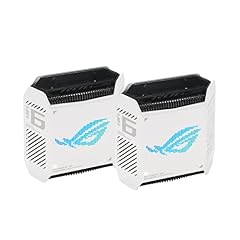
ASUS ROG Rapture GT6
- Wi-Fi standard
- Wi-Fi 6
- Bands
- Tri-band
- Coverage
- 4,001 to 6,000 sq ft
- Pack size
- 2 pack
- Mesh
- Yes
- Multi-gig port
- Yes
- Gaming
- Yes
$499.99 (as of 10/26/2026 12:08 PDT - Details)
The ROG Rapture GT6 is the only pick in this group with gaming listed as a use case and the only one with a 2.5 Gbps port in the stated specs. It is a tri-band Wi-Fi 6 mesh system, which fits a household that wants low-latency traffic handling.
Pros
- Gaming mesh with tri-band Wi-Fi 6
- Covers up to 5,800 sq ft as stated
- Includes a 2.5 Gbps port
- Two-node pack
Cons
- Only two nodes are included for the top of this coverage range
- No Wi-Fi 7 support
Good fit if
- Gamers who want a mesh system with a 2.5 Gbps port
- Homes with tri-band Wi-Fi 6 clients
Skip if
- You need three nodes for a complex floor plan
- You want the latest Wi-Fi 7 standard
Verdict: The ROG Rapture GT6 is the best mesh pick here when gaming is the main priority.
8 Best dual-band Wi-Fi 7 mesh

Amazon eero 7 dual-band mesh Wi-Fi 7 router
- Wi-Fi standard
- Wi-Fi 7
- Bands
- Dual-band
- Coverage
- 4,001 to 6,000 sq ft
- Pack size
- 3 pack or more
- Mesh
- Yes
- Multi-gig port
- Yes
$399.99 (as of 10/26/2026 22:46 PDT - Details)
The eero 7 dual-band provides Wi-Fi 7 in a three-node package with covered range for this category. It is a solid option if your internet plan is 2.5 Gbps or slower and you want the latest standard in a simpler layout.
Pros
- Wi-Fi 7 support
- Three-node package
- Supports internet plans up to 2.5 Gbps per the listing
- Dual-band layout is stated
Cons
- Dual-band layout means no dedicated third radio for backhaul
- No 5 Gbps plan support, unlike the Pro 7
Good fit if
- Homes with internet plans up to 2.5 Gbps
- Users who want Wi-Fi 7 in a three-node kit
Skip if
- You want a tri-band backhaul radio
- You need support for 5 Gbps internet plans
Verdict: The eero 7 dual-band is a clean way to get Wi-Fi 7 across a large home without a third radio.
9 Best tri-band Wi-Fi 6 with router and one satellite

NETGEAR Orbi Tri-Band WiFi 6 Mesh Network System
- Wi-Fi standard
- Wi-Fi 6
- Bands
- Tri-band
- Coverage
- 4,001 to 6,000 sq ft
- Mesh
- Yes
- Multi-gig port
- Yes
$473.68 (as of 10/26/2026 17:10 PDT - Details)
The RBK862S is a Wi-Fi 6 tri-band mesh with a router and one satellite extender. It is a leaner two-piece setup for homes that can reach 6,000 sq ft with one additional node.
Pros
- Tri-band Wi-Fi 6
- Router plus one satellite format
- NETGEAR lists security features in the product name
Cons
- Only one satellite is included, so the system may not supply the same coverage margin as three-node packs
- Number of Ethernet ports is not stated by the seller
Good fit if
- Homes where a router and one satellite are enough
- Users who want tri-band Wi-Fi 6
Skip if
- You expect a three-node mesh kit
- You need the extra coverage margin of a third node
Verdict: The Orbi RBK862S is a compact tri-band Wi-Fi 6 mesh for the middle of this coverage range.
10 Best tri-band Wi-Fi 6 for 5,000 sq ft homes

NETGEAR Orbi Whole Home Tri-Band Mesh WiFi 6 System
- Wi-Fi standard
- Wi-Fi 6
- Bands
- Tri-band
- Speed class
- 2001 to 5000
- Coverage
- 4,001 to 6,000 sq ft
- Mesh
- Yes
$429.99 (as of 10/26/2026 17:11 PDT - Details)
The RBK752 is a router with one satellite, using tri-band Wi-Fi 6 and a speed class of 2,001 to 5,000. It is a smaller mesh system for the low end of this coverage category.
Pros
- Tri-band Wi-Fi 6
- Router plus one satellite
- Speed class is stated as 2,001 to 5,000
- Coverage up to 5,000 sq ft as stated
Cons
- Only one satellite is included
- No Wi-Fi 7 support
Good fit if
- Homes up to about 5,000 sq ft
- Users who want tri-band Wi-Fi 6 without a third node
Skip if
- You need the full 6,000 sq ft coverage estimate
- You want Wi-Fi 7
Verdict: The Orbi RBK752 is a dependable tri-band Wi-Fi 6 mesh for homes near 5,000 sq ft.
Comparison table
| # | Router | Wi-Fi standard | Bands | Speed class | Coverage | Pack size | Mesh |
|---|---|---|---|---|---|---|---|
| 1 | Amazon eero Pro 7 tri-band mesh Wi-Fi 7 router | Wi-Fi 7 | Tri-band | not stated | 4,001 to 6,000 sq ft | 3 pack or more | Yes |
| 2 | NETGEAR Orbi 370 Series WiFi 7 Mesh System | Wi-Fi 7 | Dual-band | not stated | 4,001 to 6,000 sq ft | 3 pack or more | Yes |
| 3 | Tenda WiFi 7 Mesh System BE3600 | Wi-Fi 7 | Dual-band | 2001 to 5000 | 4,001 to 6,000 sq ft | 2 pack | Yes |
| 4 | ASUS Lyra Home Wi-Fi System | Wi-Fi 5 | Tri-band | 2001 to 5000 | 4,001 to 6,000 sq ft | 3 pack or more | Yes |
| 5 | Amazon eero 6 mesh wifi system | Wi-Fi 6 | not stated | not stated | 4,001 to 6,000 sq ft | 3 pack or more | Yes |
| 6 | NETGEAR Orbi 870 Series WiFi 7 Mesh System | Wi-Fi 7 | Tri-band | not stated | 4,001 to 6,000 sq ft | 2 pack | Yes |
| 7 | ASUS ROG Rapture GT6 | Wi-Fi 6 | Tri-band | not stated | 4,001 to 6,000 sq ft | 2 pack | Yes |
| 8 | Amazon eero 7 dual-band mesh Wi-Fi 7 router | Wi-Fi 7 | Dual-band | not stated | 4,001 to 6,000 sq ft | 3 pack or more | Yes |
| 9 | NETGEAR Orbi Tri-Band WiFi 6 Mesh Network System | Wi-Fi 6 | Tri-band | not stated | 4,001 to 6,000 sq ft | not stated | Yes |
| 10 | NETGEAR Orbi Whole Home Tri-Band Mesh WiFi 6 System | Wi-Fi 6 | Tri-band | 2001 to 5000 | 4,001 to 6,000 sq ft | not stated | Yes |
How this list was made
All 10 routers in the catalog for the coverage group 4,001 to 6,000 sq ft are included. Picks were chosen from the maker's stated specifications: Wi-Fi generation, band layout, number of nodes, coverage range, and extra features such as a 2.5 Gbps port or gaming mode. Where the seller did not state a specification, that is noted. Prices are shown live from the product listing. The site did not operate any of these units; the guide is based on published specifications and catalog data.
Choosing the right one
Wi-Fi generation: Wi-Fi 5, 6, and 7
The wireless standard is the first thing to check. Wi-Fi 5 (802.11ac) is the oldest in this list and still works for streaming and web use. Wi-Fi 6 adds OFDMA and other efficiency features for dense homes. Wi-Fi 7 is the newest generation and uses wider channels and higher-order QAM to reach faster speeds, but those benefits require clients that also support Wi-Fi 7. The Wi-Fi Alliance maintains the specifications for each generation.
Tri-band vs. dual-band mesh
Dual-band nodes have one 2.4 GHz radio and one 5 GHz radio (or the equivalent for the Wi-Fi generation). Tri-band nodes add a third radio, which can be dedicated to backhaul traffic between nodes. In a mesh system for 4,001 to 6,000 sq ft, a third radio can help because node-to-node traffic does not have to compete with device traffic on the same two bands. The picks in this guide show which systems state a tri-band or dual-band layout.
Node count and coverage claims
All the routers in this guide are mesh systems: multiple nodes work together to cover the stated square footage. The pack includes two or three nodes. A three-node system has more hardware to spread across a large floor plan, while a two-node system depends more on where you place each node. Coverage numbers are the maker's estimate, and actual range depends on walls, floors, and interference.
Internet plan speed support
Look at the speed your internet provider delivers. Some mesh systems state the maximum internet plan they support, such as 500 Mbps, 2.5 Gbps, or 5 Gbps. Matching the router to your plan avoids a system that becomes a bottleneck on a faster connection. The eero 6, eero 7, and eero Pro 7 entries show different plan support levels.
Security and WPA3
Wi-Fi security is a shared responsibility between the router and your clients. Wi-Fi CERTIFIED devices are required to support WPA3, and WPA3 adds protections against password-guessing attempts. NIST publishes broader cybersecurity guidance for small networks. When you set up a new mesh system, update the firmware and use a strong passphrase.
Extra features worth checking
Beyond coverage, look for a 2.5 Gbps Ethernet port if you have a multi-gig internet plan or a local NAS. Gaming routers may include optimized traffic handling, and some products list the number of devices they can support. These details are stated in the product listing and can make one mesh system a better fit than another.
Questions
Can a mesh system really cover 6,000 sq ft?
Yes, a mesh system with multiple nodes can cover that range if the coverage claim is based on a typical open floor plan. The products in this guide state coverage from 4,001 to 6,000 sq ft. Real-world range depends on wall construction, number of floors, and placement. A three-node system generally gives more flexibility for spreading coverage than a two-node system.
Should I buy a Wi-Fi 6 or Wi-Fi 7 mesh?
If all of your laptops, phones, and tablets support Wi-Fi 6, a Wi-Fi 6 mesh is enough. Wi-Fi 7 is for the newest devices and for multi-gig internet plans that can use the extra speed. Because Wi-Fi is backwards compatible, a Wi-Fi 7 router will still work with older clients, but those clients will connect at their own speed.
What does tri-band mean for a mesh system?
A tri-band mesh node has three radios: usually one 2.4 GHz and two 5 GHz (or similar for the Wi-Fi generation). The third radio can be used as a dedicated wireless backhaul between nodes, leaving the other two radios for client devices. Dual-band nodes have only two radios, so node-to-node traffic must share airtime with clients.
How many nodes do I need for 4,001 to 6,000 sq ft?
Most makers rate their three-node systems for the full 6,000 sq ft range. Two-node systems are also sold in this category, but the coverage estimate assumes the two nodes can be placed to reach each area. You may need to add another node for floor plans with long hallways or thick walls.
What should I do if I have dead zones?
Move the nodes closer to the devices that need the strongest signal. Avoid placing them inside cabinets or behind large metal objects. If your router is a two-node pack, consider whether an additional compatible node from the maker is supported. Check the maker's placement guidance for your model.
What changed
- : First published.